

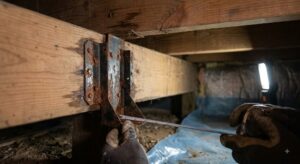
Rust on a nail, bolt, or metal connector may look minor beside a large beam, yet those small parts help hold the entire floor system together. Damp conditions can slowly weaken hardware long before wood framing shows obvious damage. Careful crawl space inspections therefore include fasteners, brackets, hangers, and support connections—not just beams and joists.
Small Metal Connections Carry More Weight Than They Seem
Fasteners transfer loads between joists, beams, sill plates, posts, and foundation supports. Nails resist sliding, bolts clamp structural members together, and joist hangers keep floor framing seated at its bearing points. Once corrosion reduces the metal’s thickness, each connection may carry less force than the original design intended.
Floor movement often begins quietly around these weakened joints. Slight separation can produce squeaks, uneven surfaces, cracked finishes, or doors that no longer close cleanly. Experienced crawl space repair contractors inspect the full connection because solid-looking lumber cannot perform correctly when the hardware holding it in place has deteriorated.
What Causes Fasteners to Rust Beneath a Home?
Humidity creates one of the most common corrosion risks. Warm outdoor air entering through crawl space vents may meet cooler ducts, pipes, or framing surfaces, causing condensation that settles on exposed metal. Repeated moisture cycles gradually attack unprotected steel, even without standing water.
Plumbing leaks add a more concentrated source of damage. Slow drips near supply lines, drains, or fixtures can soak one framing bay for months before anyone notices a stain upstairs. Hardware below bathrooms, kitchens, and laundry areas often deserves extra attention for that reason.
Ground vapor also raises moisture levels throughout the space. Exposed soil releases water into the air, especially after heavy rain or during humid Alabama summers. Homeowners searching for crawl space waterproofing near me may need a vapor barrier, drainage improvements, sealed vents, or dehumidification to protect both the wood and its metal connections.
Corrosion Can Break the Home’s Structural Load Path
Structural loads must travel continuously from the rooms above to the soil below. Joists deliver weight to beams, beams pass it into posts or piers, and fasteners keep those pieces aligned while the transfer occurs. Rusted connectors can interrupt that route and force nearby framing to absorb stress it was not meant to carry.
Visible clues may include pulled nails, split wood around bolts, loose hangers, dark streaks beneath metal plates, or gaps where framing members should meet tightly. A search for crawl space repair near me should lead to an inspection that checks these details instead of focusing only on the lowest section of floor.
Different Metals Can React Poorly When They Touch
Galvanic corrosion may occur when two dissimilar metals contact each other in the presence of moisture. For example, certain fasteners can deteriorate faster when paired with incompatible flashing, brackets, treated lumber chemicals, or connector coatings.
Pressure-treated wood also affects hardware selection. Preservatives used in modern lumber can be more corrosive to ordinary steel than older formulations. Contractors should choose fasteners and connectors rated for the specific wood treatment and exposure level rather than using standard interior hardware beneath the home.
Replacement parts must match the connection’s structural purpose. A drywall screw, light-duty bracket, or undersized nail may fit physically but lack the shear strength and corrosion resistance needed for floor framing. Qualified providers of crawl space repair in Huntsville AL use rated structural hardware suited to humid, below-floor conditions.
Repairing Rusted Hardware Starts With Moisture Control
Replacing corroded fasteners without correcting the damp environment only resets the clock. Inspectors first look for roof runoff, plumbing leaks, groundwater, open vents, torn vapor barriers, and drainage failures that keep the area wet.
Moisture readings help determine whether framing has also begun to decay. Soft wood may not hold replacement screws, bolts, or nails securely, even when the new metal is stronger. In those cases, crews may need to reinforce or replace damaged lumber before rebuilding the connection.
Drying measures depend on the source. Groundwater may call for a perimeter drain and sump pump, while humid air may require encapsulation and a dehumidifier. Exterior grading and longer downspouts can further reduce the amount of water reaching the foundation.
How Contractors Decide Which Fasteners Need Replacement
Surface rust does not always mean immediate failure, but deep pitting, flaking, section loss, or movement around the connection deserves closer review. Contractors compare the hardware’s condition with its location, load, exposure, and role within the framing system.
Critical connections often receive priority, including beam-to-post brackets, joist hangers, sill anchors, structural bolts, and support-jack attachments. New components may use hot-dip galvanized steel, stainless steel, or another corrosion-resistant finish selected for the surrounding materials.
Kennedy and Sons evaluates fastener corrosion alongside moisture levels, wood condition, drainage, pier stability, and floor movement before recommending repairs. Their team can replace weakened connections, reinforce affected framing, and address the damp conditions that caused the damage, giving property owners a more complete approach to crawl space repair.