

The Foundation: Why an Integrated Digital Strategy is Non-Negotiable
Many businesses continue to operate their digital marketing efforts in isolation. SEO teams optimize for organic search, PPC specialists manage paid campaigns, social media managers curate content, and email marketers nurture leads – often with minimal cross-communication. This siloed approach, while seemingly efficient for individual channels, creates a fragmented and often frustrating experience for the customer.
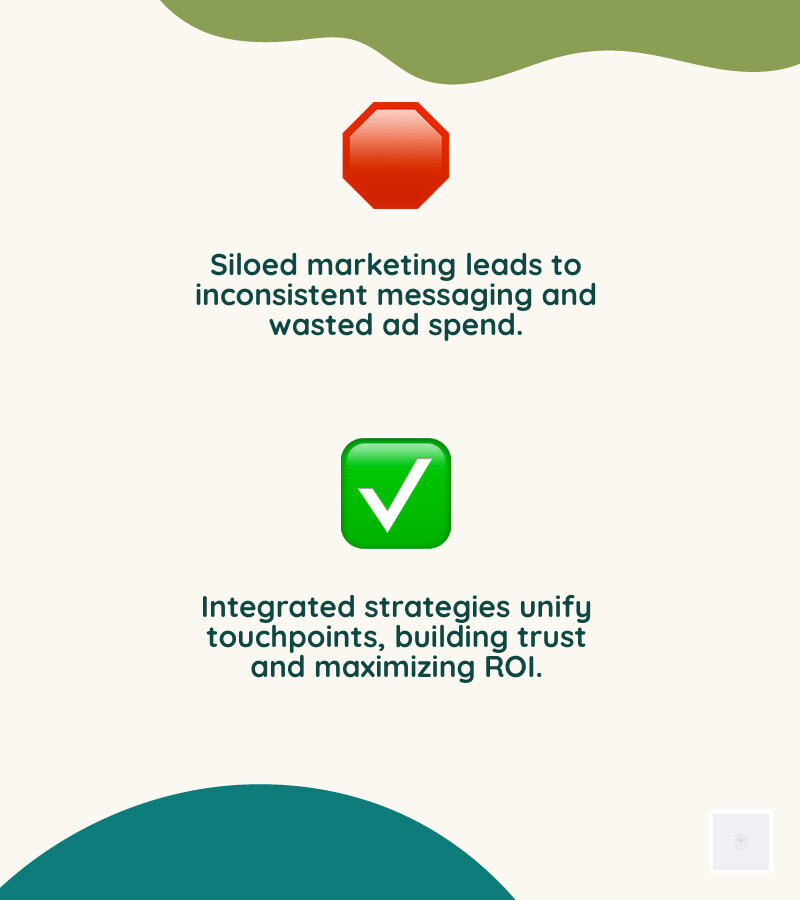
The limitations of a siloed approach are stark. Inconsistent messaging confuses potential clients, making it harder for them to grasp your brand’s unique value proposition. This leads to wasted ad spend, as different campaigns might inadvertently compete or fail to reinforce each other. A disjointed customer experience can drive prospects away, hindering business growth and undermining your return on investment (ROI).
The modern consumer journey is anything but linear. Customers engage with brands across multiple touchpoints, often switching between devices and platforms. Studies show that a significant majority of consumers—81% of shoppers—conduct online research before making a purchase. This research might involve exploring social media, reading blog posts, comparing products on review sites, and searching for specific solutions. If your brand message isn’t consistent and cohesive across these diverse interactions, you risk losing their trust and attention.
An integrated strategy, conversely, ensures that every digital touchpoint works in harmony, building trust and maximizing the collective impact of your marketing efforts.
Feature Siloed Approach Integrated Approach Brand Consistency Inconsistent messaging, fragmented identity Cohesive narrative, unified brand voice Customer Experience Disjointed, confusing, repetitive Seamless, personalized, reinforcing ROI Suboptimal, inefficient spend, difficult attribution Maximized, synergistic, clearer attribution Data Insights Fragmented, incomplete customer view Holistic, actionable, full customer journey perspective Team Collaboration Limited, internal friction High, shared goals, streamlined workflows Adaptability Slow to react to market changes Agile, responsive, continuous optimization
The Problem with a Siloed Approach
When digital marketing channels operate independently, several critical issues arise:
- Fragmented Customer Experience: A customer might see one message on Facebook, a different one in an email, and yet another on your website. This inconsistency creates cognitive friction, making it difficult for them to form a clear picture of your brand.
- Inefficient Budget Allocation: Without a unified view, budget allocation often becomes a guessing game. Channels might overspend on overlapping audiences or underspend on crucial touchpoints, leading to suboptimal results.
- Missed Opportunities: Independent campaigns often fail to leverage the strengths of other channels. For instance, valuable keyword insights from PPC might not inform SEO efforts, or engaging social media content might not be repurposed for email nurturing.
- Internal Team Friction: Different teams working in silos can lead to a lack of shared goals, duplicated efforts, and even internal competition, rather than collaboration towards a common objective.
- Last-Click Attribution Pitfalls: Over-reliance on last-click attribution models often undervalues channels that contribute to earlier stages of the customer journey, leading to misinformed budget decisions.
- Inaccurate Performance Data: Without integrated tracking and reporting, it’s challenging to get a complete, accurate picture of how different channels contribute to overall business goals, making it difficult to demonstrate true ROI.
The Power of a Unified Brand Experience
Conversely, an integrated approach harnesses the collective power of all your digital channels to deliver a unified brand experience. This consistency is paramount:
- Consistent Messaging: Every touchpoint, from an Instagram ad to a blog post, reinforces the same core message, strengthening brand recall and recognition.
- Brand Recognition: When customers encounter your brand repeatedly with a consistent look, feel, and voice, it builds familiarity and trust.
- Customer Trust: A cohesive brand presence signals professionalism and reliability, fostering greater trust with your audience.
- Reduced Cognitive Friction: Customers don’t have to piece together disparate messages; the brand narrative is clear and seamless, making their journey smoother.
- Improved Customer Lifetime Value (CLV): By creating a consistently positive and engaging experience, integrated strategies nurture long-term customer relationships. This leads to higher retention rates and increased CLV. Indeed, integrated data allows you to track the full Customer Lifetime Value (CLV) by attributing revenue accurately across multiple channels, enabling smarter Digital Marketing ROI decisions.
- Competitive Advantage: In a crowded digital landscape, brands that offer a seamless, consistent, and personalized experience stand out from competitors still operating in silos.
The Core Pillars of an Integrated Digital Marketing Framework
An effective Integrated digital marketing strategy is built upon several interconnected pillars, each playing a crucial role in reaching, engaging, and converting your target audience. These pillars often fall into categories of owned media (your website, blog), earned media (PR, social shares), and paid media (PPC, social ads). The synergy between these channels is what truly lifts a strategy from good to exceptional. It’s about creating a cohesive brand identity and a clear messaging hierarchy that guides the customer through their journey.

How SEO and PPC Work Together
Search Engine Optimization (SEO) and Pay-Per-Click (PPC) are often seen as separate disciplines, yet their combined power in an integrated strategy is formidable. When working in tandem, they create a dominant presence on the Search Engine Results Page (SERP), capturing both organic and paid traffic.
- Keyword Testing: PPC campaigns can serve as an excellent testing ground for SEO keywords. By running paid ads for various keywords, you can quickly gather data on their conversion rates and user intent before investing significant time and resources into organic optimization.
- SERP Domination: Appearing in both organic search results and paid ads for the same query significantly increases your brand’s visibility and click-through rate.
- Shared Data: Insights from Google Ads—such as top-performing keywords, ad copy variations, and landing page effectiveness—can directly inform and optimize your SEO strategy. Conversely, organic insights can refine PPC targeting.
- Lowering Overall CPA: While PPC incurs direct costs per click, the increased brand awareness and trust generated by a combined presence can lead to lower overall customer acquisition costs. Studies have shown that when SEO and paid search campaigns are run in tandem, they produce better results than using just one or the other.
- Remarketing Lists for Search Ads (RLSA): SEO efforts can drive organic traffic to your site, and visitors can then be added to remarketing lists, allowing you to target them with highly relevant PPC ads when they search again.
The Role of Content and Social Media
Content is the fuel that powers your integrated digital strategy, and social media is often the engine that distributes it.
- Content as Fuel: High-quality, valuable content (blog posts, videos, infographics, guides) addresses customer pain points, answers questions, and establishes your brand as an authority. This content is essential for both SEO (by providing keywords and valuable information) and social media (by giving you something valuable to share).
- Building Relationships: Social media platforms are ideal for fostering engagement, building communities, and interacting directly with your audience. Sharing insightful content on these platforms encourages dialogue and strengthens customer loyalty.
- Driving Brand Awareness: Consistent content sharing on social media expands your reach, introduces your brand to new audiences, and keeps you top-of-mind with existing followers.
- Earning Backlinks: When your content is valuable and shareable, it naturally attracts backlinks from other reputable websites. These backlinks are a critical factor in improving your website’s domain authority and organic search rankings.
- User-Generated Content: Social media is a powerful platform for encouraging user-generated content, which provides authentic social proof and further amplifies your brand message.
- Community Building: Beyond simply sharing, social media allows you to build loyal communities around your brand, fostering advocacy and word-of-mouth marketing.
Email Marketing: The Integration Hub
Email marketing, often underestimated, acts as a powerful integration hub, connecting various digital channels and nurturing customer relationships with unparalleled personalization.
- Personalization at Scale: Email allows for highly personalized communication, addressing subscribers by name and tailoring content based on their past behavior, preferences, and journey stage.
- Nurturing Leads: It’s an indispensable tool for nurturing leads generated through other channels (e.g., content downloads, website visits, social media sign-ups) by delivering targeted information and offers over time.
- Customer Retention: Regular, valuable email communication helps maintain engagement with existing customers, driving repeat purchases and fostering loyalty.
- Driving Conversions: Email campaigns can effectively guide subscribers towards specific calls to action, whether it’s making a purchase, downloading an asset, or signing up for a webinar.
- A/B Testing Subject Lines: Email platforms allow for easy A/B testing of subject lines, content, and calls to action, providing valuable insights that can be applied to other channels, such as ad copy or website headlines.
- Informing Content and Ad Copy: Data from email campaigns—what content resonates, which offers convert—can directly inform your content strategy and optimize your PPC and social media ad copy for better performance.
- Building Custom Audiences for Social and PPC: Your email list is a goldmine for creating custom audiences on social media platforms and for PPC campaigns, allowing you to target highly engaged individuals with specific messages.
Building Your Strategy: From Goals and Audience to Execution
Crafting an integrated digital strategy is akin to drawing a detailed roadmap for your online business growth. It requires strategic planning, foundational steps, and cross-functional collaboration across your teams. A comprehensive Digital Strategy Handbook would emphasize that success hinges on a structured approach, starting with clear objectives and a deep understanding of your audience.
Step 1: Define Clear Goals and Objectives
Before starting on any marketing effort, it’s crucial to define what success looks like. Your digital marketing goals must be directly aligned with your overall business objectives.
- SMART Goals: We advocate for setting SMART goals: Specific, Measurable, Achievable, Relevant, and Time-bound. This framework ensures your objectives are well-defined and attainable. For example, instead of “increase sales,” a SMART goal might be “increase online sales by 15% in the next six months.”
- Aligning Marketing Goals with Business Objectives: Every marketing activity should contribute to a broader business outcome, whether it’s lead generation, brand awareness, customer acquisition, or direct sales growth.
- Key Performance Indicators (KPIs): Identify the specific metrics that will track your progress towards these goals. These KPIs will serve as your compass, guiding your strategy and allowing for data-driven adjustments.
- Impact of Clear Goals: The power of clear goals cannot be overstated. A goal-setting impact report highlighted that 98% of companies saw better visibility into performance after using clear goal systems. This clarity is especially vital when coordinating efforts across diverse digital channels.
Step 2: Identify and Understand Your Target Audience
Knowing who you’re talking to is fundamental to any effective marketing strategy. An integrated approach demands an even deeper understanding of your audience’s behaviors across different platforms.
- Market Research: Conduct thorough market research to identify demographic, psychographic, and behavioral characteristics of your ideal customers.
- Buyer Personas: Create detailed buyer personas—semi-fictional representations of your ideal customers. These personas should include their pain points, goals, motivations, online habits, and preferred communication channels.
- Customer Journey Mapping: Map out the typical customer journey, from initial awareness to post-purchase advocacy. Understand where and how your audience interacts with digital content and what questions they have at each stage.
- Segmentation: Segment your audience into smaller groups based on shared characteristics. This allows for more personalized and relevant messaging across different channels.
- Pain Points and Behavioral Data: Focus on understanding your audience’s challenges and how their online behavior reflects these needs. This insight is crucial for tailoring content and offers. Even niche fields require a specialized integrated digital legal strategy to reach the right clients, emphasizing the universal need for audience understanding.
Step 3: Develop and Distribute Your Content
Content is the cornerstone of engagement, and in an integrated strategy, it needs to be developed and distributed strategically across all relevant channels.
- Content Formats: Diversify your content formats to suit different channels and audience preferences. This could include blog posts, videos, infographics, podcasts, case studies, whitepapers, and interactive tools.
- Content Atomization: Take a large piece of “pillar content” (e.g., a comprehensive guide) and break it down into smaller, digestible pieces for various platforms. A whitepaper can become a series of blog posts, social media snippets, email tips, and even short videos.
- Content Calendar: Develop a comprehensive content calendar that outlines what content will be created, for which persona, to achieve which goal, and on which channels it will be distributed.
- Distribution Channels: Strategically distribute your content across your owned (website, blog), earned (PR, influencer mentions), and paid (social ads, native advertising) channels.
- Importance of Content: Content Marketing Institute research shows that 71% of B2B marketers reported content marketing becoming more important to their organization in the last year. Creating a cohesive Integrated Digital Strategy requires content that serves each stage of the funnel, guiding prospects from awareness to conversion. For a practical blueprint, explore the Integrated Digital Strategy approach.
Step 4: Integrate Offline and Online Marketing
The customer journey often blends physical and digital interactions. A truly holistic strategy bridges this gap, ensuring a seamless experience regardless of the touchpoint.
- Seamless Customer Experience: Your brand’s message, visuals, and tone should be consistent whether a customer encounters you online or offline.
- QR Codes: Use QR codes on print materials (flyers, brochures, business cards) to direct customers instantly to landing pages, social profiles, or special online offers.
- In-Store Promotions: Promote your digital channels (social media contests, email sign-ups) within your physical store, and conversely, use online ads to drive foot traffic with special in-store offers.
- Event Marketing: Leverage digital channels to promote offline events (webinars, trade shows, local gatherings) and use the events themselves to gather digital leads and content.
- Cross-Promotion: Ensure your traditional advertising (TV, radio, print) includes clear calls to action that direct audiences to your digital properties for more information or engagement. This creates a feedback loop, as discussed in engaging customers across channels.
- Consistent Branding: From the logo on your storefront to your website’s favicon, maintain visual and tonal consistency. This reinforces brand identity and builds trust across all interactions.
Measuring Success and Optimizing for the Future
The digital landscape is dynamic, and consumer behavior is constantly evolving. Therefore, an integrated digital strategy isn’t a one-time setup; it requires continuous tracking, measurement, and optimization. This data-driven approach ensures agility and future-proofing, allowing businesses to adapt their strategies to technological advancements and shifting market trends. Think of it as a continuous digital change roadmap that you’re constantly refining.

How to Track and Analyze Your Integrated Digital Strategy
Effective measurement is the backbone of optimization. To truly understand the performance of your integrated strategy, you need unified reporting and sophisticated analytical tools.
- Unified Reporting Dashboards: Consolidate data from all your digital channels into a single, comprehensive dashboard. This provides a holistic view of your performance, allowing you to see how different channels contribute to overall goals.
- Multi-Touch Attribution: Move beyond last-click attribution to understand the full customer journey and assign credit to all touchpoints that influenced a conversion. This provides a more accurate picture of channel effectiveness.
- Google Analytics: A fundamental tool for tracking website traffic, user behavior, conversions, and identifying trends.
- CRM Data: Integrate your Customer Relationship Management (CRM) system with your marketing platforms. This allows you to track lead progression, customer interactions, and ultimately, the CLV generated by your marketing efforts.
- Key Metrics (CPA, CLV, ROAS): Focus on business-centric metrics like Cost Per Acquisition (CPA), Customer Lifetime Value (CLV), and Return on Ad Spend (ROAS) to measure the true impact of your integrated campaigns.
Essential tools for tracking and analysis include:
- Semrush: For SEO, content, and competitive analysis.
- Google Analytics: For website performance and user behavior.
- Buffer: For social media scheduling and analytics.
- Other tools like Pipedrive (CRM), Sender (email marketing automation), Canva (content creation), and Grammarly (writing assistance) also play crucial roles in managing and optimizing various aspects of an integrated strategy.
The Growing Role of AI and Automation
Artificial Intelligence (AI) and automation are no longer futuristic concepts; they are integral to modern integrated digital strategies, enabling greater efficiency, personalization, and predictive power.
- Improved Personalization: AI algorithms can analyze vast amounts of customer data to deliver hyper-personalized content, product recommendations, and offers across email, website, and ad platforms.
- Predictive Analytics: AI can forecast future trends, identify potential customer churn, and predict which leads are most likely to convert, allowing for proactive strategy adjustments.
- Campaign Optimization: AI-driven tools can optimize bidding strategies in PPC, personalize ad creatives, and even suggest optimal timing for content distribution, maximizing campaign performance.
- Workflow Automation: Automation streamlines repetitive tasks such as email sequencing, social media scheduling, lead scoring, and reporting, freeing up human marketers to focus on strategic initiatives.
- Content Generation: AI tools like ChatGPT and WRITER can assist with content ideation, drafting ad copy, generating email subject lines, and even creating basic content pieces, accelerating content production.
- Smarter Decision-Making: By processing and interpreting complex data sets, AI provides actionable insights that lead to more informed and effective marketing decisions.
Key Trends Shaping the Future of Integration
The digital marketing landscape is constantly evolving. Staying ahead requires an understanding of emerging trends and a willingness to adapt.
- Privacy-First Marketing: With increasing consumer awareness and stricter regulations (like GDPR and CCPA), privacy-first approaches and the reliance on first-party data will become paramount.
- First-Party Data: Brands will increasingly focus on collecting and leveraging their own customer data, reducing reliance on third-party cookies and external data sources.
- Voice Search: The rise of voice assistants means optimizing content for conversational queries and featured snippets will be crucial for SEO.
- Video Marketing: Short-form video (TikTok, Reels) and long-form video (YouTube) continue to dominate consumption, making video an essential component of content and social strategies.
- Shoppable Content: Integrating e-commerce directly into social media posts, live streams, and interactive ads will shorten the path to purchase.
- The Metaverse: While still nascent, the metaverse and immersive experiences represent a potential future frontier for brand engagement and advertising.
- Adaptability and Curiosity: As technology advances, the ability to adapt and maintain a curious mindset becomes a key digital skill. As one source notes, curiosity is a key digital skill for leaders navigating the digital age.
Frequently Asked Questions about Integrated Digital Strategy
What is the most important component of an integrated digital strategy?
There is no single “most important” component; the power of an integrated strategy lies in the synergy between all components. However, a deep understanding of your target audience and clear, measurable goals are the essential foundation upon which all pillars (SEO, content, PPC, social media, email) are built. Without these, even the most sophisticated channel tactics will lack direction and impact.
How can a small business with a limited budget implement this?
Start small and focus on synergy. Instead of trying to be on every channel, pick two or three that are most relevant to your audience and where you can consistently deliver value. Ensure your messaging is consistent across them. For example, use PPC data to inform your organic SEO efforts, and repurpose a single piece of pillar content (like a blog post) into social media updates and an email newsletter. Focus on quality over quantity, and leverage free or affordable tools for analytics and automation. The key is to make each channel reinforce the others, even with limited resources.
What are the biggest challenges in implementing an integrated strategy?
The most common challenges are organizational silos (where marketing teams operate independently without communication), a lack of a unified data and analytics platform, and difficulty in attributing success across multiple touchpoints. Overcoming these requires strong leadership to champion cross-functional collaboration, a commitment to breaking down internal barriers, and investment in the right technology stack to create a single source of truth for performance data. Regular communication, shared KPIs, and a culture of continuous learning are also crucial.
Conclusion
The digital world has moved beyond simple websites and isolated campaigns. To thrive in this complex, multi-channel environment, businesses must adopt an integrated digital strategy. Moving beyond silos is not merely a tactical upgrade; it’s a fundamental shift towards a more effective, customer-centric, and data-driven approach to marketing.
By fostering synergy between SEO, PPC, content, social media, and email marketing, we can create a powerful, unified brand experience that resonates with customers at every touchpoint. This holistic strategy not only maximizes your ROI and drives sustainable business growth but also builds lasting trust and loyalty. The future of marketing is integrated, and for any business aiming to succeed online, a holistic strategy is not just a tactic, but a fundamental business philosophy.